Thursday, November 23, 2006

Key Player in Largest Scientific Scandal Promoted by SJTU


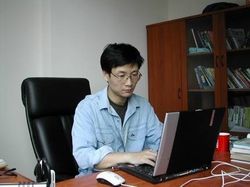
The No. 2 person in the largest scientific scandal in history, Dr. Fu Yuzhuo (homepage at SJTU) was recently promoted to full professorship from associate professor by Shanghai Jiao Tong University (SJTU) for his dedication in organization the scandal, as well as in the cover up and clean up process after the scandal was revealed by newspaper.

Dr. Fu Yuzhuo graduated from the Department of Computer Science at the National University of Defense Technology (NUDT), and received a PhD in Computer System and Architecture from Harbin Institute of Technology in 2001 under advisor Fang Binxing. Dr. Fu is the Associate Dean of the School of Microelectronics at SJTU. His major achievement is the notorious Hanxin DSP chip, a 10 years Hoax where a DSP chip was claimed to be made, but rather used a re-labeled Motorola chip to cheat billions of research funding from the government. Dr. Chen Jin, the director of the group was sacked after a high profile media coverage of the scandal. However Dr. Fu the co-founder, co-director and chief 'architect' of the non-existent chip was promoted by the SJTU for his excellent job in covering up and damage control.

It was also revealed that the Department of Computer Science at the NUDT cheated the government 3 year Y80 million research funding to develop an Operating System KYLIN. They downloaded an open source FreeBSD system, and presented it as their research fruit.

HYSIS Hoax, updates 1, 2, 3, 4, 5

Tuesday, November 21, 2006

Chinese Government Does not Trust Made-In-China


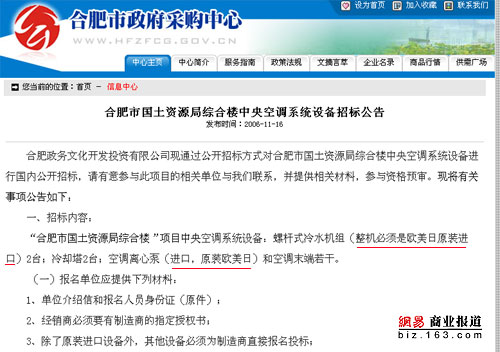
Hefei government published an air-conditioning purchase announcement on Nov 16, which explicitly excluded any made-in-China products in participation, not even those with foreign brand and only assembled in China. Lack of technical specification, the announcement only required that the air-conditioning must be imported in its entity (not in parts and then assembled in China). Actually, this has been the case for years. The Chinese government does not trust made-in-China product. Whatever they say on the newspaper and TV, they do not want to use made-in-China product themselves. The Party Boss Mr. Li of the Bureau of Homeland Resources told the reporters of Anhui Business News that they must use the 'best' product.

What's even more ironic and drama is that the Hefei government just signed a deal with the Gree Air-conditioning Company to build a manufacture base that will produce 30 million air-conditioner per year, or one thirds of the world market.

Hefei is the capital city of Anhui Province in Central China.

Monday, November 20, 2006

President Hu's Gift

Chinese President Hu Jintao started his India visit today. He brought with him a gift, an unearthed Buddhapada stone made in China 1500 years ago. Buddhaim spreaded to China as early as 200 B.C. Lack of authentic scriptures, people had been using liberty in interpreting the true meaning of Buddhism. Monk Xuanzhuang went to Inida in 627 A.D. to study Buddhaim and bring back sutras. This Buddhapada was made by Monk Xuanzhuang.

The issue at stake is whether the CCP boss has the legitimacy to give national treasure as gift to foreign government?

Thursday, November 16, 2006

Indian American Better Educated and Wealthier

According to figures recently released by the Census Bureau, 68.2% of the Indian American population hold bachelor or higher degrees, while only 52.4% of Chinese Americans hold bachelor or higher degrees. The median household income of Indian American families is $73,575, while the corresponding number for Chinese American families is $59.571.

Indian also has more students studying in the US. Last year, there's 76,503 Indian students studying in the US, while the corresponding number for Chinese is 62,582 (mainland).

Monday, November 13, 2006

Tianjin the best city for investment

The World Eminence Chinese Business Association released the list of Top 100 Chinese Cities for Investment in the Year of 2006. Tianjin topped the list with an overall score of 26.80 (the lower the better). Also in the list, Shanghai scored 31.91, Guangzhou 32.00, Beijing 34.27, Shenzhen 60.27, Zhengzhou 64.00, Xi'an 78.27, Kunming 81.18, Yangzhou 96.82, Wurmqi 99.30, Lanzhou 117.91, Haikou 123.45, Guilin 133.18.

The overall index is comprised of economic development, infrastructure, human resources, consumer environment, and living environment.